Biodiversity expedition to Kerala
A field journey through the Western Ghats, one of the world’s great biodiversity hotspots
A specialist natural-history journey linking Kerala’s coast, forests, wetlands and high mountains. It was originally prepared for professionals: botanists, zoologists, ornithologists, ecologists and experienced naturalists. Five or six places are still free, and we are happy to offer them to amateur botanists and nature lovers with a genuine interest in plants and wildlife.
A transect across exceptional diversity
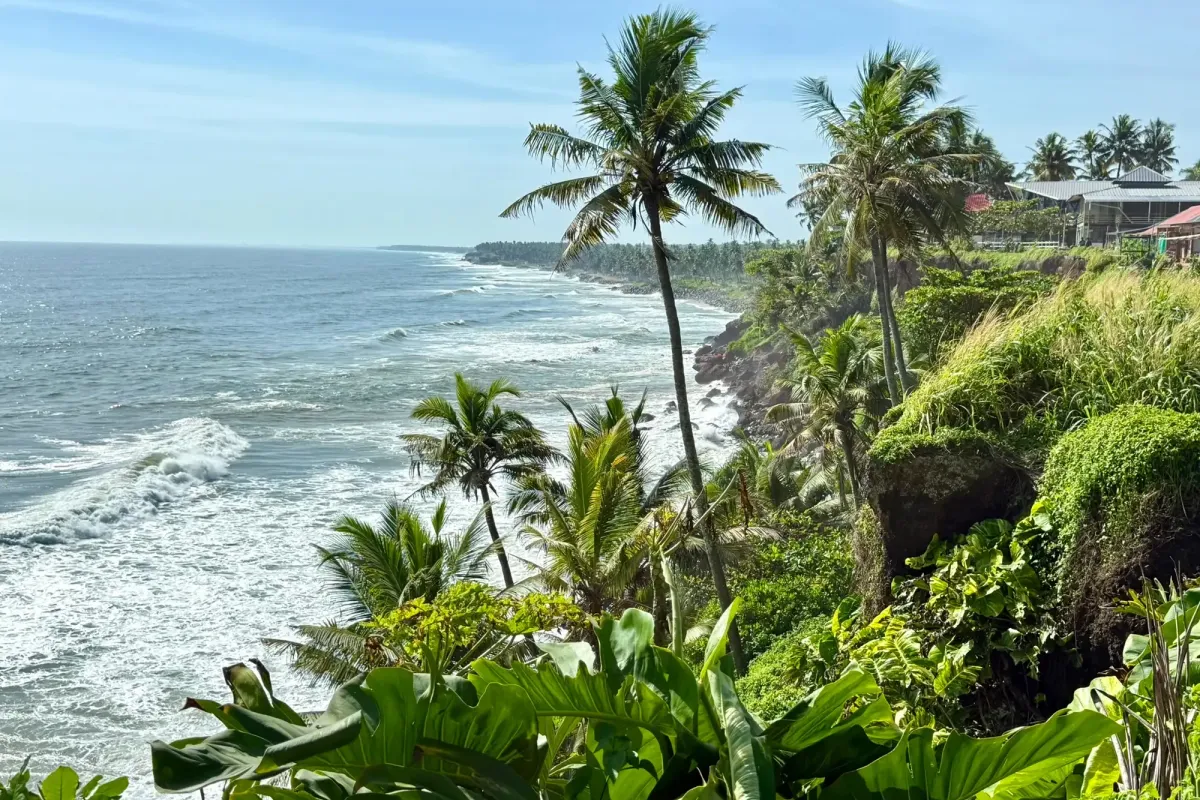
From the Arabian Sea and lowland wetlands through evergreen and rain-shadow forests to shola, montane grassland and tea landscapes in the high Western Ghats.
Field observation, not conventional sightseeing
The programme emphasises habitats, plants and animals, local scientific guidance and time to understand ecological transitions rather than simply visit landmarks.
Gallery
Which ecosystems will we explore?
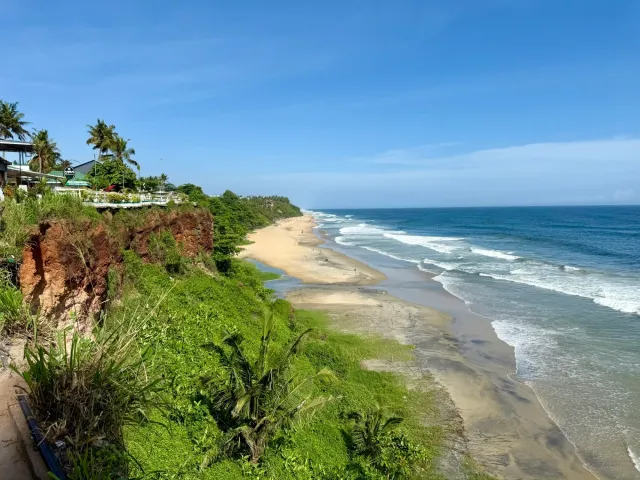
Kerala’s coastal ecosystems
At Kolavi, Thikkodi, Kappad and Calicut Beach we will examine tropical strand vegetation and the transition between land and sea. Typical elements include Ipomoea pes-caprae, Spinifex littoreus, Pandanus, Calophyllum and coconut-dominated littoral vegetation, together with estuarine and shallow-water fauna.
Flora: goat’s-foot creeper (Ipomoea pes-caprae), a classic sand-binding pioneer on tropical beaches; screwpine (Pandanus odorifer), a characteristic woody element of the coastal fringe. Fauna: olive ridley sea turtle (Lepidochelys olivacea), which seasonally nests on parts of the Kerala coast; Indo-Pacific humpback dolphin (Sousa chinensis), a striking marine mammal of nearshore waters.
Kadalundi mangroves and estuary
Kadalundi Community Reserve combines tidal channels, mangrove vegetation and rich birdlife. Mudskippers, crabs, prawns and estuarine fishes occupy the intertidal zone, while herons, kingfishers, waders, plovers and terns use the mudflats and waterways.
Flora: Rhizophora mangrove (Rhizophora apiculata), representative of Kerala’s estuarine habitats; Avicennia mangrove (Avicennia officinalis), another characteristic tree of tidal wetlands. Fauna: mudskippers (Periophthalmus spp.), amphibious fishes adapted to exposed mud; smooth-coated otter (Lutrogale perspicillata), a charismatic semi-aquatic mammal of quiet estuaries.
Myristica swamp forest
At Vallikattukavu we will visit one of the most unusual Western Ghats habitats: waterlogged evergreen forest dominated by nutmeg-family trees. Stilt roots, buttresses and knee roots are adaptations to saturated soils; specialised amphibians and caecilians occupy the wet forest floor.
Flora: Myristica swamp tree (Gymnacranthera farquhariana), which develops conspicuous knee roots above waterlogged soil; swamp syzygium (Syzygium travancoricum), a Critically Endangered endemic tree. Fauna: dancing frogs (Micrixalus spp.), famous for toe-waving displays beside forest streams; caecilians (Ichthyophis spp.), limbless amphibians living in wet organic soil.
Evergreen forests of Thusharagiri and Wayanad
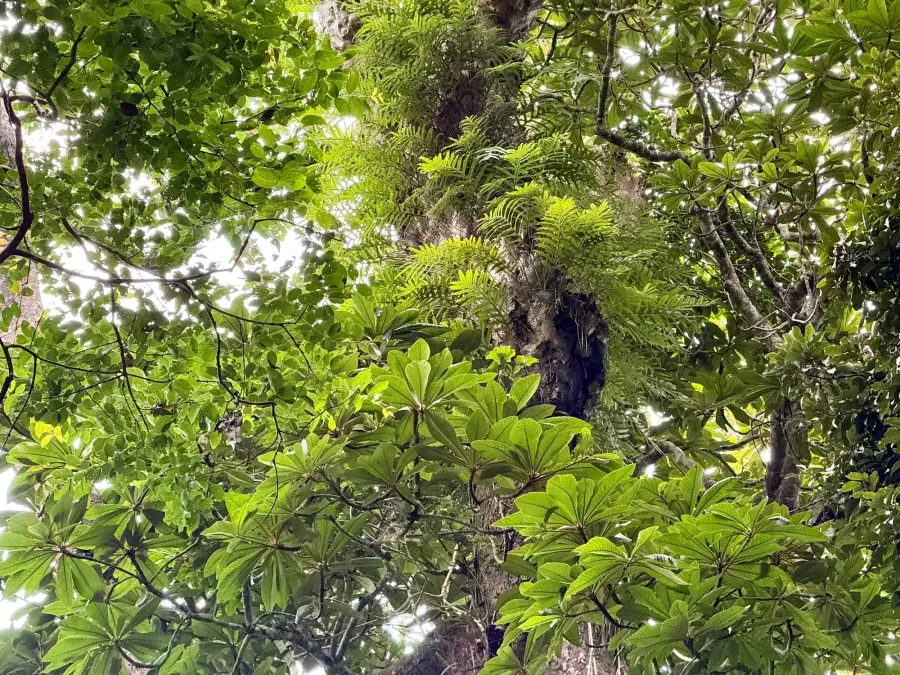
These mid-elevation forests have a multilayered canopy with Cullenia, Mesua, Palaquium and wild nutmegs, together with canes, ferns, balsams and a rich epiphytic orchid flora. We will look at canopy layering, epiphytes, forest-edge transitions and changes in vegetation with rainfall and elevation.
Flora: wild durian (Cullenia exarillata), a major canopy tree and food source for endemic mammals; wild nutmeg (Myristica dactyloides), a characteristic shade-tolerant tree. Fauna: lion-tailed macaque (Macaca silenus), one of the best-known rainforest primates of the Western Ghats; Malabar giant squirrel (Ratufa indica), a large arboreal squirrel of forest canopies.
Silent Valley National Park
A major rainforest landscape protecting tropical moist evergreen forest in the Nilgiri Hills and important endemic Western Ghats fauna. Forest specialists such as lion-tailed macaques, Nilgiri langurs, shieldtail snakes and many bush frogs are closely tied to these ancient mountain habitats.
Flora of the high-elevation shola forests: Nilgiri rhododendron (Rhododendron arboreum subsp. nilagiricum), a relict high-elevation plant; the epiphytic orchid Coelogyne mossiae, associated with cool, moist shola forest. Fauna: shieldtail snakes (Uropeltis spp.), specialised burrowing snakes of moist shola humus; endemic bush frogs (Raorchestes spp.), a highly diverse Western Ghats group.
Chinnar, a dry forest in the rain shadow
Chinnar Wildlife Sanctuary lies in the rain shadow of the Western Ghats and includes dry deciduous forest, thorn scrub and riparian habitats. Sandalwood, Hardwickia, Anogeissus and Boswellia are representative plants.
Flora: Indian sandalwood (Santalum album), naturally present in the Chinnar–Marayoor landscape; Indian frankincense (Boswellia serrata), adapted to steep, dry slopes. Fauna: grizzled giant squirrel (Ratufa macroura), the flagship mammal of Chinnar Wildlife Sanctuary; Indian star tortoise (Geochelone elegans), an iconic dry-zone reptile.
Munnar, Kolukkumalai and Eravikulam
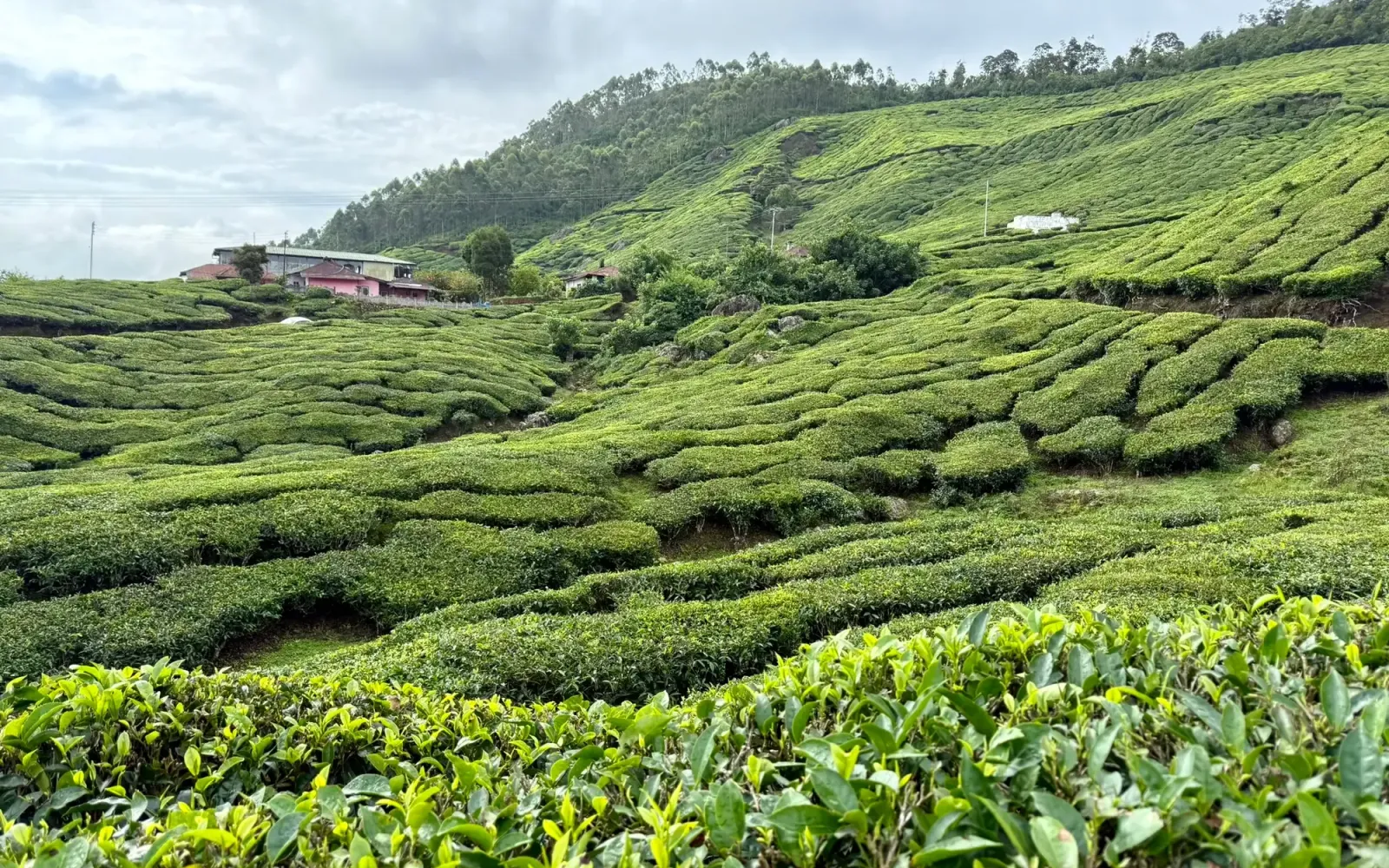
Tea plantations form a striking managed landscape in the high Western Ghats. Eravikulam National Park protects a high-elevation mosaic of shola forest and montane grasslands and is famous for the endemic Nilgiri tahr.
Flora: Neelakurinji (Strobilanthes kunthiana), a famous mass-flowering shrub with a 12-year cycle; wild balsams (Impatiens spp.), colourful high-elevation herbs with many endemic species. Around the tea gardens: silver oak (Grevillea robusta), widely planted as a fast-growing shade tree, and Macaranga peltata, a pioneer of secondary vegetation. Fauna: Nilgiri tahr (Nilgiritragus hylocrius), the iconic mountain ungulate of Eravikulam; Nilgiri pipit (Anthus nilghiriensis), an endemic of high-elevation tussock grassland; Malabar barbet (Psilopogon rubricapillus) and Asian fairy-bluebird (Irena puella) along forest edges and secondary growth.
Vagamon, montane landscapes
Open meadows, wooded patches and secondary vegetation provide a useful comparison with the shola-grassland system around Munnar.
Kadamakkudi island wetlands
Near Kochi, an estuarine island landscape with open water, aquatic vegetation and rich birdlife reconnects the route with Kerala’s lowland wetlands.
Flora: mangrove trumpet tree (Dolichandrone spathacea), a mangrove-associated tree; sea holly (Acanthus ilicifolius), a spiny associate of tidal wetlands. Fauna: Oriental darter (Anhinga melanogaster), the long-necked snakebird of open wetlands; pheasant-tailed jacana (Hydrophasianus chirurgus), adapted to floating vegetation.
Itinerary
Detailed timing remains subject to field conditions, access regulations and final coordination with MBGIPS. The species named above are representative of the habitats, not a guaranteed checklist; observations will be interpreted with MBGIPS and local experts.
Day 1Saturday 14 NovemberDeparture from Europe
International travel to South India.
Day 2Sunday 15 NovemberArrival in Kozhikode
Arrival at Calicut International Airport; acclimatisation day.
Day 3Monday 16 NovemberMalabar Botanical Garden
Orientation and specialist visit to KSCSTE-MBGIPS.
Day 4Tuesday 17 NovemberKadalundi and Vallikattukavu
Mangrove-estuarine ecosystem and Myristica swamp forest.
Day 5Wednesday 18 NovemberKerala coast
Kolavi, Thikkodi, Kappad and Calicut Beach: coastal ecosystems.
Day 6Thursday 19 NovemberThusharagiri and Wayanad
Transition into mid-elevation evergreen forests.
Day 7Friday 20 NovemberWayanad Wildlife Sanctuary
Tholpetty and Soochipara: forests and wildlife observation.
Day 8Saturday 21 NovemberSilent Valley National Park
Tropical moist evergreen rainforest of the Nilgiri Hills.
Day 9Sunday 22 NovemberChinnar Wildlife Sanctuary
Rain-shadow dry deciduous forest and dry-zone fauna.
Day 10Monday 23 NovemberMunnar and Eravikulam
Tea landscapes, shola forests, montane grasslands and Nilgiri tahr habitat.
Day 11Tuesday 24 NovemberVagamon
Montane meadows, wooded patches, lake and secondary vegetation.
Day 12Wednesday 25 NovemberKadamakkudi
Island, wetland and estuarine landscape near Kochi.
Day 13Thursday 26 NovemberKochi
Lighter day for sightseeing, shopping and your own programme.
Days 14–1527–28 NovemberDeparture
Transfer to Cochin International Airport and return to Europe.
Who is this expedition for?
For botanists, zoologists, ornithologists, ecologists and committed amateur naturalists with an established interest in biodiversity, conservation and field observation. Participation is subject to confirmation by the organiser.
Group of approximately 15–25 participants. The programme is led in English and Czech.
How we travel
A specialist field programme with full local logistics. From Kozhikode to Kochi we travel in a private air-conditioned coach, with local taxi or auto-rickshaw transfers where needed; boat cruises and the listed local activities are included.
Accommodation
Premium three- to four-star Executive or Deluxe hotels. Rooms for two have twin beds or one double bed depending on the hotel, as is standard in India. All rooms have air conditioning and an en-suite bathroom with shower and hot water. Single occupancy is available for an additional charge.
Meals
Breakfast, lunch and dinner every day. Breakfast and lunch are mainly buffets; dinner is a buffet or set menu, with vegetarian choices at every meal. Field days use packed lunches or designated eco-tourism dining. Please declare dietary preferences and allergies when you register.
Expert guidance
MBGIPS staff and local botanist and zoologist experts, guides and escorts. Site admissions, local permits, entry permissions and levies are included.
International travel
Flights are not included. Arrival at Kozhikode (Calicut International Airport), departure from Cochin International Airport. We recommend suitable connections so the group arrives and leaves together.
Scientific cooperation
The expedition is organised by Deveshwar Travels s.r.o. in cooperation with KSCSTE – Malabar Botanical Garden & Institute for Plant Sciences in Kozhikode, under the patronage of its Chief Scientist, Dr N. S. Pradeep.
Our field programme begins in Kozhikode with an introduction, orientation and specialist visit to MBGIPS, a Government of Kerala institution focused on plant diversity, conservation and research, including aquatic and wetland plants, lower plant groups and endangered flora of the Malabar region.
€1,220
per person in a double or twin room
The price is per person sharing a double or twin room. Single occupancy is available for an additional charge; the details are in the programme we send by email. International flights are not included; we recommend suitable connections for a coordinated arrival and departure.
The price includes
- Premium three- to four-star hotels with air conditioning and en-suite bathrooms
- Breakfast, lunch and dinner daily, with packed lunches or eco-tourism dining on field days
- Private air-conditioned coach, with local taxi or auto-rickshaw transfers where needed
- Boat cruises and the listed local activities
- Orientation and specialist visit at KSCSTE-MBGIPS
- MBGIPS staff, local botanist and zoologist experts, guides and escorts
- Site admissions, local permits, entry permissions and levies
The price does not include
- International flights
- Single-room supplement
How to join the journey
Tell us you are interested.
Leave your name, email and phone in the short form below. It is free and does not oblige you to book.
Receive the details by email.
You get a PDF with the full programme, hotels, the single-room supplement, the deposit and the booking conditions.
Confirm your interest.
A link in that email opens a form for the travellers’ details needed for the contract.
Sign the contract.
We prepare the tour contract from your details and send it to you to sign.
Pay the deposit and you are in.
Once the deposit arrives, your place is confirmed and we help with flights and visas.
Good to know
- Final registration deadline: 31 October 2026. Passport details are required in early November for forest and park permits.
- No biological collecting. The expedition is for observation, photography and field study only. Collecting any biological material (herbarium specimens, seeds, plant parts, tissue samples, insects or other zoological material) is not permitted unless a specific official permit has been obtained in advance.
- Detailed timing remains subject to field conditions, access regulations and final coordination with MBGIPS.
- Participation is subject to confirmation by the organiser.
Thank you, we have your enquiry.
We will get back to you personally, usually within two working days, with the full information and the next steps.
Other journeys
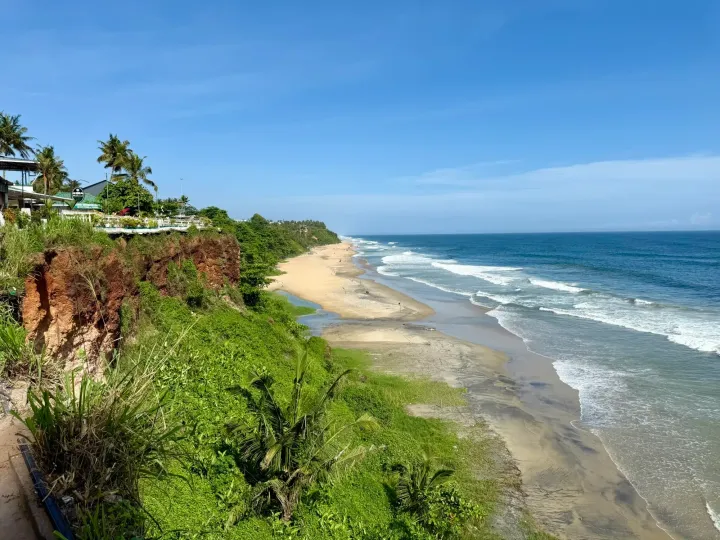
The magic of South India
Tamil Nadu, Puducherry and Kerala
Travel from the great temple cities of Tamil Nadu across the Western Ghats into the tropical landscapes of Kerala. In sixteen unforgettable nights we encounter living spiritual traditions, walk among tea plantations, explore the forests and waters of Periyar, spend a night aboard a houseboat and rest beside the Arabian Sea.
View the journey →€1,850 per person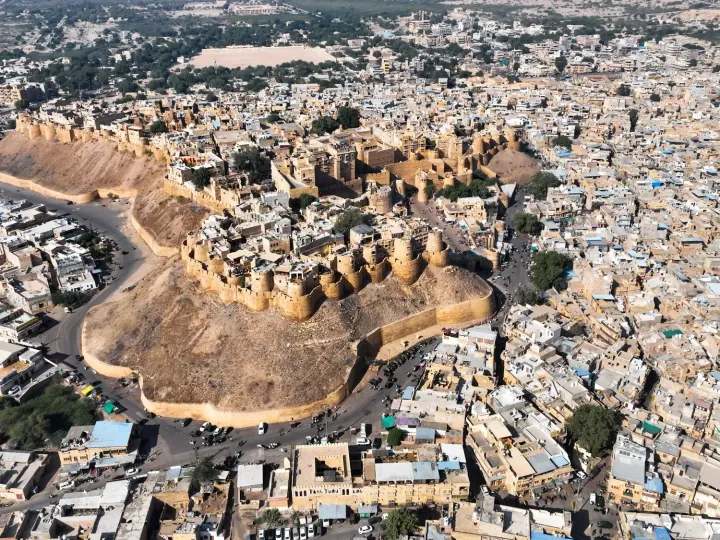
Treasures of Rajasthan
Jaipur, Marwar, the Thar Desert and Mewar
A fourteen-day private group journey through Rajasthan, from the royal cities of Jaipur, Jodhpur and Udaipur to the Thar Desert, the sacred lake of Pushkar, the marble temples of Ranakpur and a night inside Om Ashram. Morning yoga, a measured pace and time for the atmosphere of each place.
View the journey →€1,600 per person